
Do you need tools for GEO? Measuring brings clarity, but only a real editorial process moves things forward
A measurement tool takes a snapshot of your visibility with AIs; it does not change it. What matters is a comprehensive editorial process, without promises of citations.
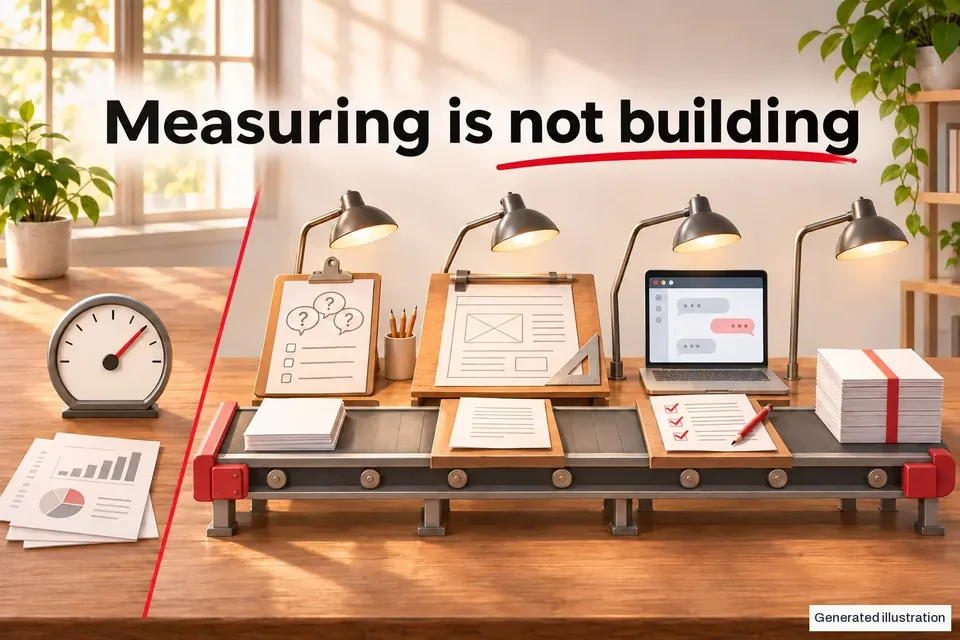
Measuring, yes, but for what purpose?
We are often asked whether one needs to invest in tools for GEO—that is, working on brand presence within AI assistant responses. Our answer is nuanced. Measuring is useful, but a dashboard remains a snapshot: it tells you where you stand on a given day, but does not change the course of things. For a company as for an agency, the real challenge lies elsewhere.
Besides, measurements are not lacking. In June 2026, Google launched reports dedicated to generative search in Search Console. On our end, we provide access to reports indicating which AI crawlers consult pages, on which topics, and in which languages. This information helps interpret a situation. But reading is not writing: visibility is built through what you publish, not what you observe.
Google itself specifies that, from its perspective, optimizing for generative search amounts to doing SEO. It recommends applying the same core best practices. In other words, there is no magic button or secret formula hidden in a tool. There is regular, careful editorial work, and that is precisely the area where we choose to support you.
Your website doesn't tell the whole story
Here is a finding that often comes as a surprise: among all the sources cited by AI, a brand's own website occupies a minimal place. This changes how we think about it. Looking after your site remains essential, but it is not enough. And the stakes are real, because a brand absent from generative AI recommendation lists becomes invisible to its potential customers.
This is why we champion the idea of multiplying external sources of information. Specifically, every week, we simultaneously publish news updates on the client's website and on third-party specialized media. We edit and manage sixteen thematic websites, a number that will evolve according to our clients' needs. Your profiles and offers find their place there, on sites designed to be read by artificial intelligence as well.
This presence addresses two very concrete situations. First, that of a prospect asking an AI directly about a product's reputation: they can then find an external source of reassurance. Second, that of a buyer formulating a broad query without a specific brand in mind: the goal is to position oneself within the answers. In both cases, what is at stake extends far beyond your website alone.
A process, from design to distribution
A prompt entered alone into a chat produces text. It does not produce an editorial line, a rhythm, or a presence anywhere other than on your own site. Our work covers the entire chain: design, writing, and automated distribution of news and editorial content for businesses. Each step feeds the next, and it is this continuity that gives value to the work.
Take design. We structure content around questions buyers commonly ask in their market, then refine it to align with the expectations of generative models. We start from what your customers are actually searching for, not what we would like to say about ourselves. Then comes the writing and distribution, both on your site and on third-party specialized media.
We also like to rely on observation. During tests conducted in September 2026, we internally analyzed 8,061 pages across 3,273 websites. This informs our perspective on the subject. As for the rules of the game, Google allows AI-generated content if it is useful and reliable, while warning against large-scale generation of low-originality content. For us, quality comes before volume.
What we do not promise
Let us be clear, out of respect for you: our service cannot guarantee that an AI will actually select and cite published pages. Nor can we promise a specific ranking or score in generated responses. Building a strong editorial presence increases the opportunities to be found, nothing more. Any firmer promise would, in our view, be telling tall tales.
We also need to keep a cool head about what "being cited" means. According to a 2026 study, only about 1% of AI Overviews consultations result in a click to one of the mentioned sources. Appearing in a response is therefore primarily a matter of visibility and reassurance, not a guaranteed flow of visitors. It is better to know this from the start to set realistic expectations.
So, do you need tools? Why not, to see where things stand. But the real work starts after the snapshot: designing, writing, distributing, week after week, on your site and beyond. If you are a company or an agency and want to establish this process without spending your days on it, that is precisely what we do: communicating to be visible, simply.
Sources
- In June 2026, Google launched dedicated reports in Search Console for performance in generative search features.
- Google notes that GEO and AEO are terms one might encounter, but optimizing for generative search, from its perspective, amounts to doing SEO.
- Google: Use the Generative AI performance report in Search Console and apply the same foundational SEO best practices for inclusion in AI Overviews/AI Mode.
- Google allows AI-generated content if it is useful and reliable, and warns against large-scale generation of low-originality content.
- A 2026 study finds that about 1% of AI Overviews visits result in a click to a cited source.